Tree Height
[20 Minutes]
Recently, scientists have found that the tallest that any tree can grow is about 426 feet (130 meters). They studied the massive redwood trees in California. The redwood tree is the tallest living thing on earth and often grows to a height of 393 feet (120 meters) or more. These trees are taller than the Statue of Liberty (318 feet, or 97 meters). If you look in a forest or a local park, you will notice that each type of tree (such as maple, oak, or pine trees) tends to grow to a maximum height that is more or less that other trees. You can measure the height of these trees to see how high each type grows.
You'll need:
• a wooden stick, about 3 feet long. • a pencil • a notebook or paper that you can write measurements in • measuring tape
What to do:
- If possible, print out these directions. Read them through before you begin.
- Gather everything you'll need and always remember science safety.
- Measure the height of a friend in feet and inches (or centimeters if you like).
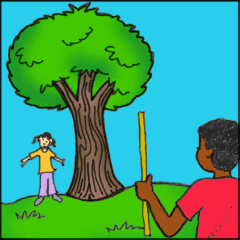
- Have your friend or an adult stand next to a tree.
- Walk far enough from the tree so that you can hold out your hand in front of you and cover your friend with the fingers of your hand.
- Hold the stick with a straight arm in front of you so that the top of the stick is level with the top of your friend’s head.
- Mark the height of your friend on the stick by making a pencil mark below the top of the stick at a point that looks even with her feet.
- Hold the top of the stick level with the top of the tree.
- Mark the height of the tree on the stick by making another pencil mark at a point that looks even with the base of the tree.
- Determine how many times taller the tree is than your friend.
- Measure and record the distance between the top of the stick and the mark for your friend’s feet.
- Measure and record the distance between the top of the stick and the mark for the tree’s base.
- Use the measurements from the stick and divide the tree’s height by your friend’s height. The number you get shows how many times taller the tree is compared to your friend. This number may be 2 or 200!
- Multiply this number by the true height of your friend (what you measured with the measuring tape) to get the height of the tree!
- For example:
if your friend is 6 inches tall on the stick and the tree is 30 inches tall, then the tree is ( 30 divided by 6 = ) 5 times as tall as your friend.
If your friend measured 4 feet tall with the measuring tape, then the tree is ( 5 times 4 = ) 20 feet tall
- Record this height in your notebook along with the type of tree.
- If you don’t know the type of tree, write down a description of the leaf shape or get a leaf sample and you can find the exact name later. Leaf shape is a very good clue to determining the exact name of the tree.
- Measure the height of other trees so that you get a record of 3 to 5 tree heights for several different types of trees. Look over your measurements and see if each type of tree has a similar maximum height.
Useful information:
Scientists said that the reason that the redwoods can’t grow any taller, like the beanstalk in the ‘Jack and the Beanstalk’ story, is that it is very hard for a tree to pull water all the way to the top of the tree to satisfy the thirst of the leaves that make the tree grow. In deserts and dry areas the trees are much shorter mostly because there is little water in the ground and the tree has to work just as hard as a redwood to get water to its leaves. Other important ingredients to tree height are soil type (rocky or sandy), altitude, and how the tree grows and spreads it seeds. Pine trees are often the tallest type of tree in a forest as they have their leaves all year.
|