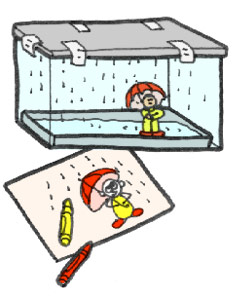
Let It Rain
[30 Minutes]
The water drops in clouds range in size from .000079 inches to .0039 inches. These tiny drops band together and form larger drops. When the drops become too heavy for the clouds to support them, they fall as rain. Falling raindrops range in size from .24 inches to.79 inches. Using an empty aquarium and some boiling water, find out how to make it rain!
You'll need:
• stove or hot plate (ADULT USE ONLY) • pot of water • large empty aquarium (10 gallon size or larger) • shallow pan that fits into the bottom of the aquarium • large cookie sheet that fits over the entire top of the aquarium • tape • small plastic figure of a person holding an umbrella (optional) • paper • pencil and crayons
What to do:
- If possible, print out these directions. Read them through with your child before you begin.
- With your child, gather everything you'll need.
- Boil about six cups of water in a pot on the stove.
- Help your child place the shallow pan in the bottom of the empty aquarium. If you have a small plastic figure, you may wish to place it on the side at the bottom of the aquarium.
- Pour boiling water into the shallow pan.
- Let your child quickly cover the aquarium with the cookie sheet and help him tape it down tightly.
- Observe what happens inside the aquarium.
- Encourage him to write down what happens and draw a picture of his observations.
How to use:
Use this as a science experiment to show how the water cycle works.
Let's Talk: Ideas to Explore Together.
- Why did it rain inside the aquarium?
- Why does it rain outside?
- When you take a hot shower, why does it seem to almost "rain" on the bathroom mirror or window?
Useful information:
When the water on earth in the form of lakes, rivers, and oceans is heated by the sun, invisible water vapor rises into the air. This is called evaporation. As the water vapor rises, it cools and condenses into tiny droplets of water just as the water in the pan does. As the droplets in the air come together, a cloud forms. Rain, or precipitation, occurs when the droplets become so heavy that the air currents can no longer hold them up. Much of the rain that falls on our earth eventually flows back into the lakes and oceans. In simple terms, this is what our water cycle is all about. Watch your local weather forecast. If rain is predicted, think about what is developing in the air to make this happen.
|