Thin Skinned
[30 Minutes]
Do you want to learn some advanced scientific terms (really big words)? Believe it or not, this fun activity will introduce you to some words that you’ll use often in your education. They all revolve around the science of biology, the study of living things. Let’s have fun, and later, you can try these words out on your older friends and family. They’ll be impressed!
You'll need:
• a clear glass jar with a lid • white vinegar • one raw egg
What to do:
- If possible print out these directions. Read them through with your child before you begin.
- With your child, gather everything you’ll need.
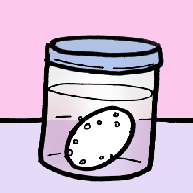
- Let your child place the egg inside the jar.
- Help your child pour white vinegar inside the jar until the egg is covered.
- Challenge your child to put the lid on the jar.
- Together, observe for three days.
Let's Talk: Ideas to Explore Together.
- How did the egg change?
- Why did the egg have bubbles all over it?
- Why did the egg get bigger?
Useful information:
Have you ever heard of limestone? Did you know that that is what an egg’s shell was made out of? Scientists call it calcium carbonate. You have just witnessed a chemical change. Vinegar caused a change in the limestone that caused carbon dioxide gas to be produced, thus causing the bubbles. The thin rubbery membrane around the egg that was underneath the shell is still there, holding the egg together. The egg got bigger due to another scientific word, osmosis. Liquid moved through the membrane and made the egg get a little bigger. If you measure the circumference of the egg before and after the experiment, you would notice and increase. I bet you’re wondering why the liquid inside the egg to not escape into the vinegar? It is because the molecules of the liquid inside the egg are too large to fit through the little holes in the membrane. This ability of some materials to fit through a membrane and some not, is called semi permeability. Whew! That was a lot to learn!
|